An exploration of colour, geometry, and the unexpected nature of perception.
What happens when colour refuses to follow a single direction?
At first glance, ChromaTwist presents an intricate dance of sweeping curves, intersecting lines, and vibrant colour. Red, yellow, green, cyan, blue, and magenta flow through the composition, creating an energetic interplay of overlapping forms and geometric relationships. Against the contrasting black and white, these six colours establish a sense of movement, depth, and visual complexity.
Yet beneath this colourful arrangement lies a carefully concealed transformation.
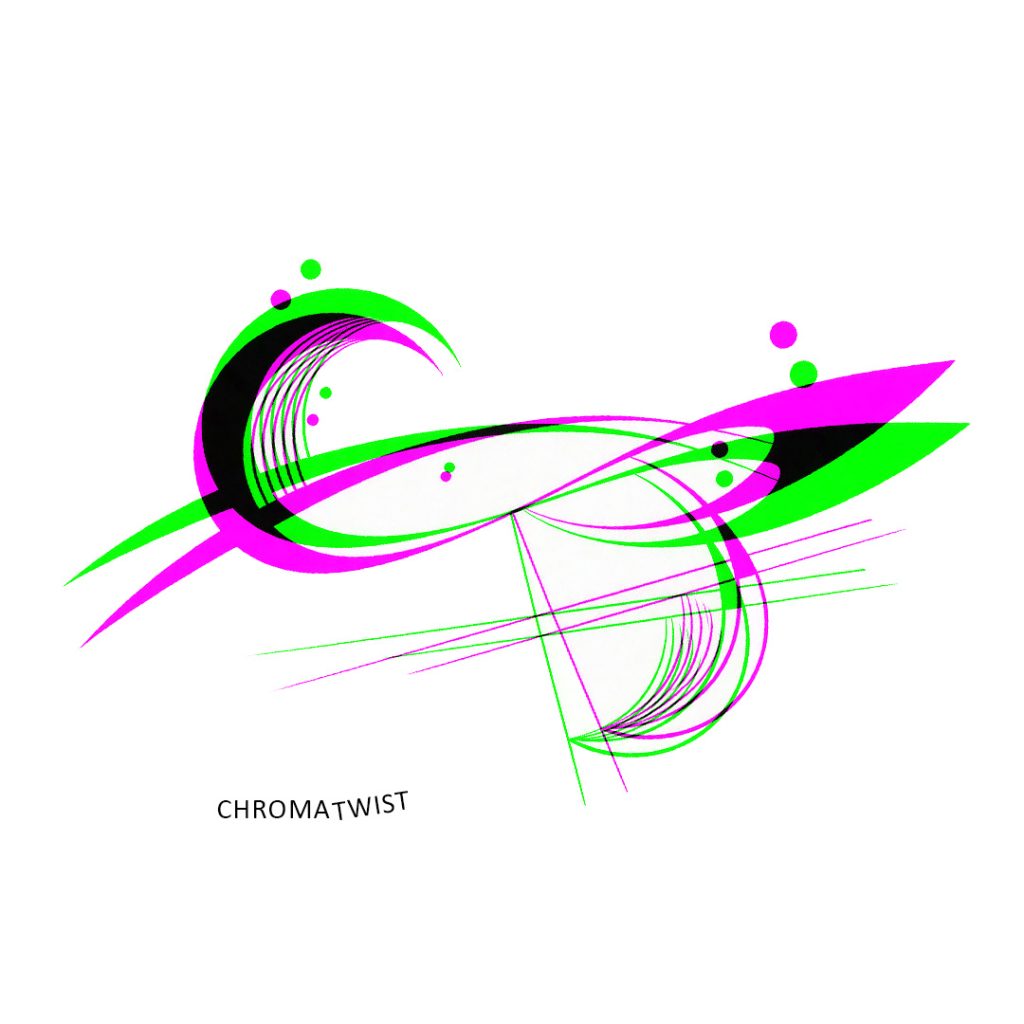
When viewed through a prism at the correct orientation and viewing distance, the six-colour palette converges into just two colours: green and magenta, accompanied by black and white. The apparent complexity gives way to a strikingly simplified composition, revealing an entirely different visual experience.
But look a little closer.
On the left side of the composition, magenta appears beneath green. Follow the forms across the image, however, and something unexpected happens. On the right, magenta appears above green.
The same two colours. The same prism. Two opposing arrangements.
Ordinarily, a consistent chromatic displacement produces a predictable relationship between colours. In Chroma-Twist, that expectation is challenged. The apparent order changes across the composition, creating an intriguing contrast within an otherwise continuous visual experience.
Nothing about the prism has changed. The optical principles remain the same. Yet the composition presents two seemingly contradictory colour relationships at once.
Is it an illusion of movement? A consequence of geometry? Or is something more subtle hidden within the colours themselves?
The answer lies somewhere in the relationship between light, arrangement, and observation.
Chroma-Twist invites viewers to explore the difference between seeing colour and understanding it, demonstrating how a seemingly simple change in perspective can reveal an unexpected complexity.
Sometimes, the most interesting twists are the ones we cannot immediately see.