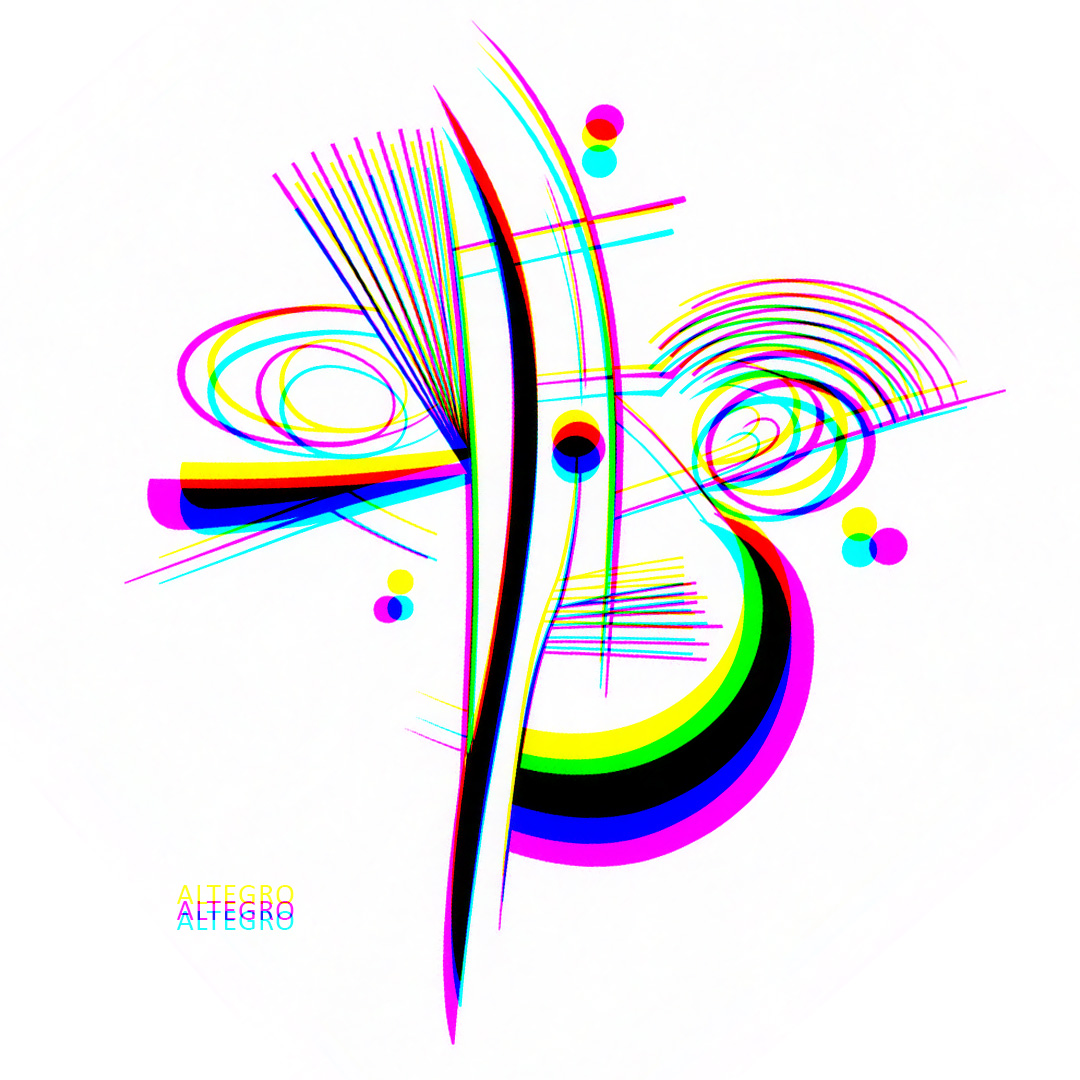
Part alter ego, part allegro, Altegro describes a composition with two visual identities. Its colours appear fragmented and energetic to the naked eye, then reorganize through the prism into a second, more restrained state.
To the naked eye, Altegro is an energetic abstract composition of sweeping curves, repeated arcs, intersecting lines, circles, and strong geometric forms. Multiple colours are deliberately offset from one another, creating chromatic trails around the underlying geometry. These separations give the composition its sense of movement and rhythm.
But the visible colour arrangement is only one state of the work.
When Altegro is viewed through a prism at the correct orientation and focal distance, the prism acts on those carefully calculated colour offsets. Colours that appear separated in the original image are optically shifted back toward one another, causing the broader palette to converge.
The Reveal
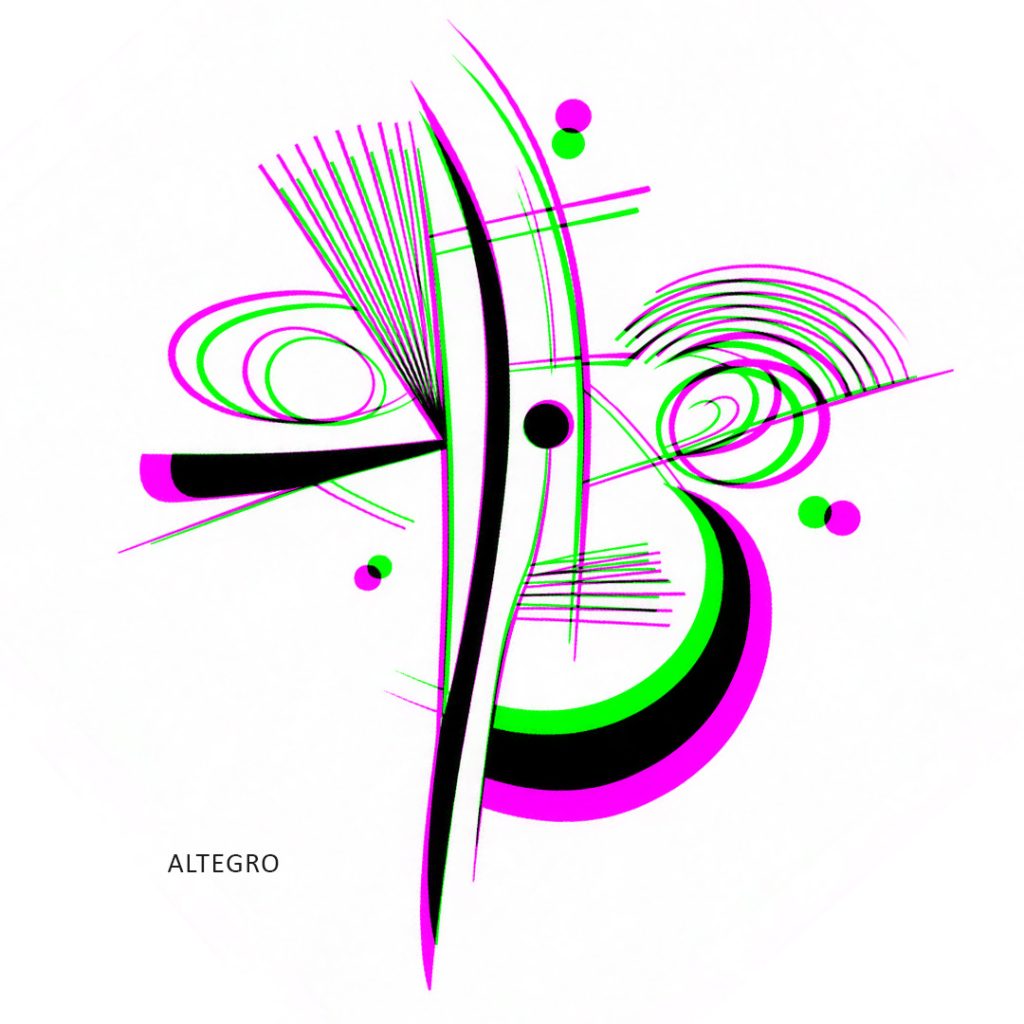
The result is the revealed version of Altegro: a dramatically reduced composition of magenta, green, black, and white.
The underlying geometry remains, but its chromatic character has changed. Lines that previously carried several displaced colours now resolve into cleaner relationships of green and magenta, while black forms regain their visual weight against the white background.
This transformation gives the title its meaning. Altegro has an alter ego — a second chromatic version deliberately encoded within the first and revealed by the prism.
The reference to allegro also reflects the visual character of the work. Long sweeping curves accelerate through the composition, repeated line groups establish rhythm, and circular forms punctuate the movement like notes within a score.
Yet the transformation itself is not an animation and the artwork does not physically change. The prism reveals a colour state already engineered into the image through the placement and displacement of its colours.
Altegro therefore explores an unusual relationship between image and optical device: the artwork is designed not only for the unaided eye, but for a second way of seeing it.