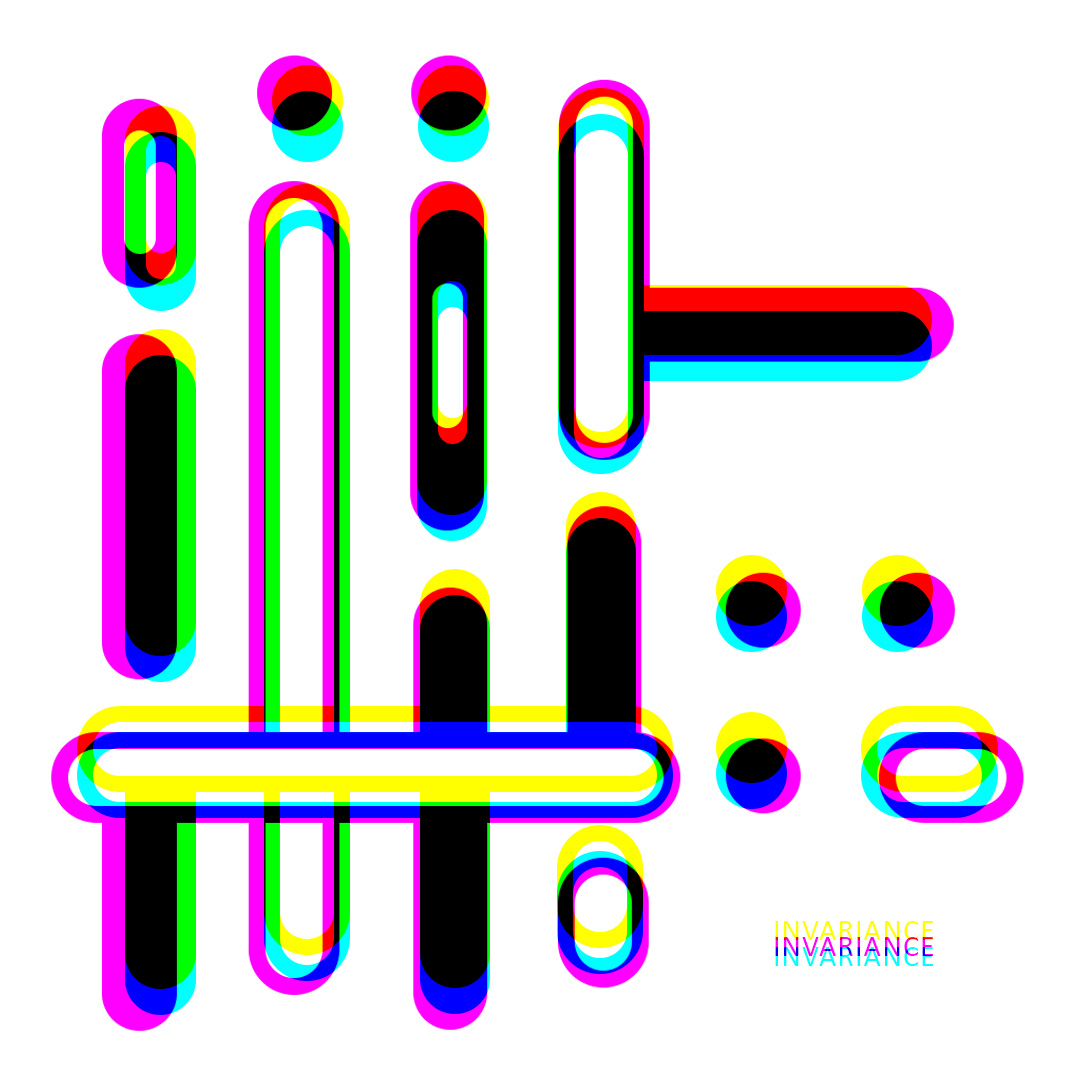
Invariance explores the tension between variation and constancy.
To the unaided eye, the work presents a field of geometric forms constructed from differently displaced colour channels. Circles, loops, elongated capsules, intersecting paths and rounded structures each appear to follow their own chromatic logic. Their offsets vary from shape to shape, creating an image that seems intentionally irregular, almost as though each form has been assigned a different optical condition.
Yet when the work is viewed through a prism from the intended position, much of that apparent complexity disappears.
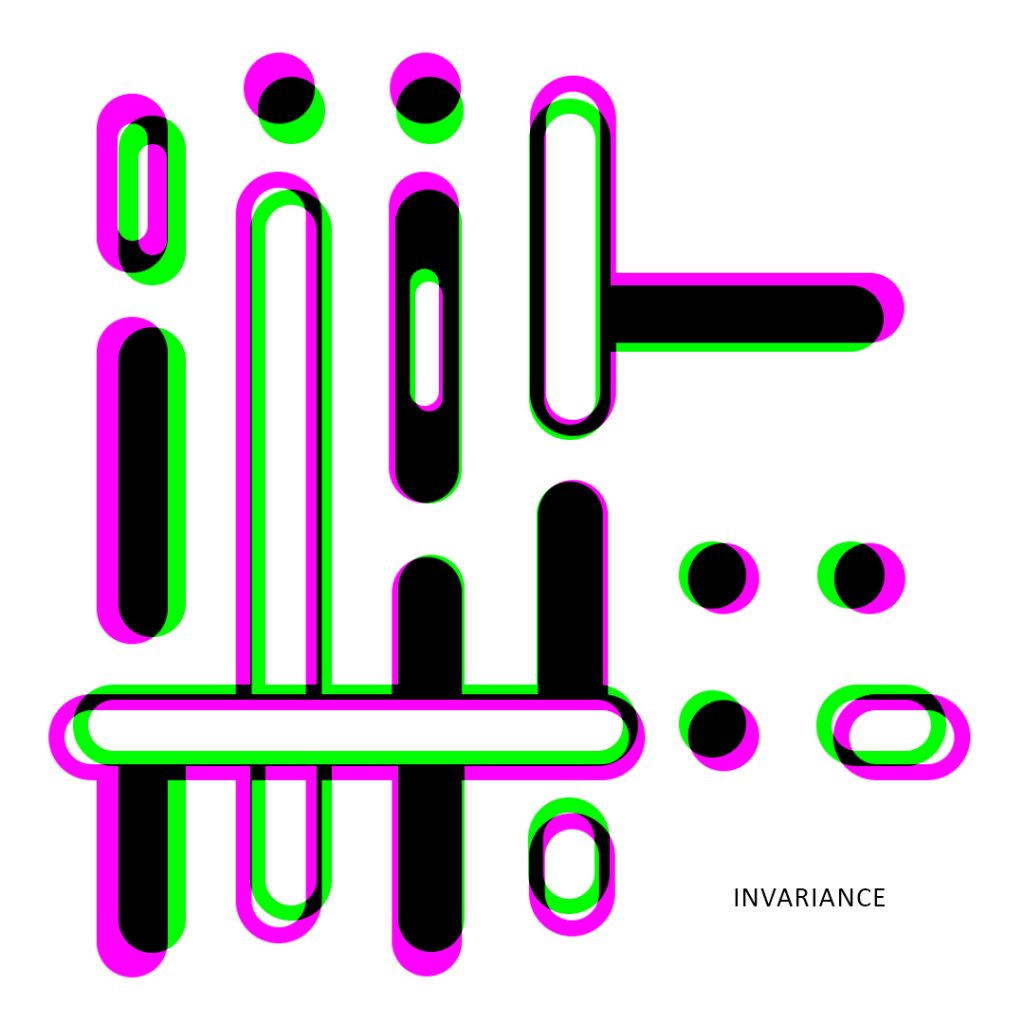
The colours resolve into a reduced visual language of magenta, green, black and white. Forms that begin with different chromatic offsets arrive at remarkably similar optical states.
The prism therefore becomes more than a device for separating colour. It becomes an instrument of comparison.
What appears different under ordinary observation reveals an underlying equivalence when subjected to the same optical transformation.
The title Invariance draws from mathematics and physics, where an invariant is a property that remains unchanged while a system undergoes transformation. Here, the transformation is perceptual and optical. Colour relationships shift, boundaries migrate and visual information is reorganized, yet a common chromatic structure remains.
The resulting image is unexpectedly restrained.
Black acts as a visual anchor, giving many of the forms a sense of density or interior mass. Around it, magenta and green occupy opposing edges, creating a subtle impression of polarity. The colours appear less like decoration and more like states distributed around a boundary.
The rounded geometry softens the precision of the construction. Long forms terminate gently, circular elements overlap like cells or apertures, and narrow loops resemble conduits, membranes or field structures. The work suggests motion without depicting motion directly. Colour seems to travel around the forms, collecting along edges and bending through their contours.
This softness creates a tension with the underlying logic of the piece. The image is carefully constructed, but the revealed state feels almost organic.
Different conditions produce different paths.
Yet the prism exposes the same destination.
Many offsets. One outcome.